Fall is here! I love Fall. I love wearing scarves and jackets, carving pumpkins, and drinking hot punch. But most of all I love to hike through the beautimous leaves. Here's some pics of me and Terry on one of our hikes.
In light of recent events, today’s post is all about
Wilderness Safety. Recently I went on a night hike with my roommate and narrowly
avoided being attacked by a skunk, several beavers, and a mountain lion! It certainly
was an adventure! And besides that the stars were beautiful, the
exercise invigorating, and the company delightful. But now perhaps you’ve
never encountered any of the above mentioned wild animals? With the absolutely
perfect weather we’re having and the brilliant leaves adorning the mountains (see the beautiful pictures?), I
strongly encourage you to go for a hike! But before you go, take the quiz below
to test your wilderness survival skills.
Question 1- When encountering a mountain lion, the most effective way to
avoid being attacked is to:
a)
a Hope that it just goes away
b)
b Pray that he doesn’t spring from the trees and
bite you in the head
c) c Employ the self-defense skills you learned in
school and attack it before it can attack you
d)
d Be able to outrun your companion
Question 2- Apart from their unpleasant aroma skunks are a health hazard
as a rabies vector species. Which of the following statements about rabies is
true?
a a The Michael Scott's Dunder Mifflin Scranton
Meredith Palmer Memorial Celebrity Rabies Awareness Pro-Am Fun Run Race For the Cure proved to be an effective
method of combating rabies in the US
b) b
Foxes, raccoons, bats and skunks are the four wild
animals considered primary carriers of rabies
c)
c When we happened upon a skunk on our night hike I
was thinking mostly about the danger of contracting a rabies infection
d)
d When you
encounter a skunk in the wild, you will be thinking about the danger of
contracting a rabies infection
Question 3- Answer yes or no to the following statements:
a)
a Beavers never attack humans
b)
b Even if beavers wanted to attack humans they
lack the conviction to try
c)
c Having in your possession a flashlight, a
waterbottle, and a set of keys will help you feel confident encountering a
potential beaver attack
d)
d If a beaver smacked his tail on the water and
there was no one around to hear it, would it make a sound?
Bonus Question: What is the scariest animal on the planet?
How'd you do? Here are the answers:
Question 1- When encountering a mountain lion, the most effective way to
avoid being attacked is to:
a)
a Hope that it just goes away
b)
b Pray that he doesn’t spring from the trees and
bite you in the head
c) c
Employ the self-defense skills you learned in
school and attack it before it can attack you
d)
d Be able to outrun your companion
‘a’, ‘b’, and ‘d’
are all correct answers to this question. Answer ‘c’ is not recommended. Though
it may have appeared that I employed
the technique in answer ‘d’ on our recent night hike as I shoved Terry out of the
way to run to the car, I was actually acting
as a decoy to draw the mountain lion’s attention. The fact that I reached the
car first was merely incidental.
In all seriousness,
if you ever do encounter a mountain lion, the safest response is to make
yourself look as large as possible (hold up sticks, wave your arms), keep
looking at the mountain lion (although not directly in the eyes) and make noise
and yell. Do not run. Mountain lions are most active at dusk and after dark.
They rarely attack humans, especially groups of humans, but if they do attack
fight back! Their glowing eyes at night
are ca-reepy!
Question 2- Apart from their unpleasant aroma skunks are a health hazard
as a rabies vector species. Which of the following statements about rabies is
true?
a) a
The Michael Scott's Dunder Mifflin Scranton
Meredith Palmer Memorial Celebrity Rabies Awareness Pro-Am Fun Run Race For the Cure proved to be an effective
method of combating rabies in the US
b)
b Foxes, raccoons, bats and skunks are the four wild
animals considered primary carriers of rabies
c)
c When we happened upon a skunk on our night hike I
was thinking mostly about the danger of contracting a rabies infection
d) d When you
encounter a skunk in the wild, you will be thinking about the danger of
contracting a rabies infection
‘a’ answer: though
there hasn’t been any conclusive evidence to the fact, simple logic dictates
this statement is most likely true
‘b’ this is true,
although rabies is usually transmitted by dogs (more a neighborhood hazard than
a hazard of the wilderness)
‘c’ false, I was thinking
that night hikes might not be the brightest idea after all
‘d’ false, you will
be wondering if tomato juice really works on skunk stink
Question 3- Answer yes or no to the following statements:
a)
a Beavers never attack humans
b)
b Even if beavers wanted to attack humans they
lack the conviction to try
c) c
Having in your possession a flashlight, a
waterbottle, and a set of keys will help you feel confident encountering a
potential beaver attack
d)
d If a beaver smacked his tail on the water and
there was no one around to hear it, would it make a sound?
‘b’ No, I’m
fairly confident that had we not left the premises with reasonable swiftness
that beaver would have tried to bite our heads
‘c’ No, though
we carried all such precautions, the seemingly irrational fear of a beaver
attack stayed soundly stuck to the cranium
‘d’ This
question is up for debate. When we came across several dozen trees downed along
the trail we wandered over to the stream wanting to catch a glimpse of some
beavers. Shining our headlamps into the pond we did indeed see a beaver. I
assumed he would disappear once he saw our light, but instead he headed
straight for us at an alarming speed, and when he was nearly at the water’s
edge I thought for sure he was going to spring from the water teeth bared!
Instead he made a little leap from the water, and plunged back down slapping
his tail on the surface and making a cracking noise that sounded like a gun shot!
In the quiet stillness of the night it was alarming to say the least! Then we
heard another one, “Bam!” and another “Bam!” as other beavers followed suit. It
was a truly a fascinating phenomenon and kind of magical, if a little eerie. I
had no idea beavers could be so forceful but I looked it up on Wikipedia and
apparently this is pretty common behavior. “They are known for their
alarm signal: when startled or frightened, a swimming beaver will rapidly dive
while forcefully slapping the water with its broad tail, audible over great
distances above and below water. This serves as a warning to beavers in the area.”
If you want to see beavers doing this for yourself head up to Temple Fork at
night. So cool to watch them zipping around in their little pool!
Bonus
Question: What is the scariest animal on the planet?
This was a
trick question. The scariest animal on the planet would probably be a hippo, or
a crocodile or something else living in Africa. But in Utah, it is most
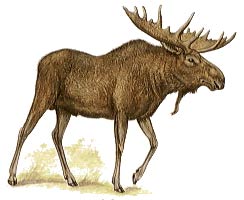
definitely the Moose! I could not create a post on wilderness safety and not
include a warning about this vicious animal. By the way, I’ve encountered Moose
on several occasions in Blacksmith Fork Canyon, so be especially wary in this
area.
Moose
facts:
--A bull moose can weigh more than 1400 pounds and it can be 6
to 7 feet tall at the shoulders and 6 to 9 feet long.
--More people are killed each year by moose than by bears.
--Moose can swim 6 miles an hour and can run as fast as 35
miles per hour.
--Moose can be extremely aggressive, especially a cow
protecting her young. They can attack with their antlers but generally use
their sharp hooves to trample their victims. Their hooves can kick out at any
direction.
--You can tell that a moose is going to attack if the hairs on
its hump stick up and its ears are laid back. It might also paw and stamp the
ground (as my friend Emma found out) If a moose charges you, run like crazy!
They’re faster than you but it’s your only chance.